Why Weather-Resistant Farming Drones Are Becoming a Non-Negotiable Tool for UK Growers
The Reality of Working a British Sky
Ask anyone who sprays or spreads seed for a living, and they will tell you the same thing: the weather does not wait. A field that needs a nitrogen top-up or a cover crop sowing does not care that the forecast shows rain by mid-afternoon. For years, ground rigs and tractors were the only option when conditions turned, but they carry their own risks. Wet soils mean compaction, and compaction means lost yield before the crop even gets going. That is where weather-resistant farming drones have started to change the conversation.
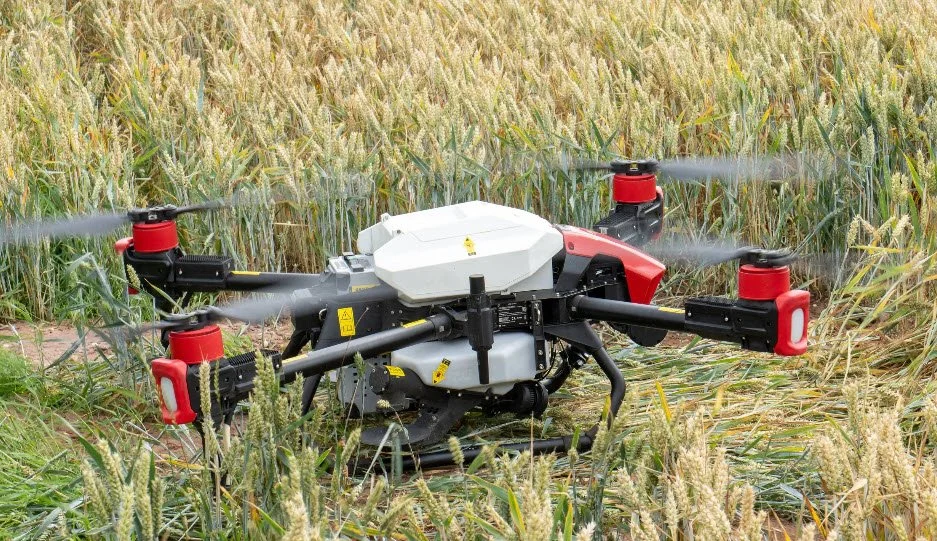
I have spent enough time standing in muddy gateways watching a forecast turn to know that timing is everything. The difference now is that a drone can be ready to fly the moment there is a break in the weather, and the latest machines are built to handle more than a light drizzle. The phrase weather-resistant farming drones is not just marketing spin. It reflects real engineering decisions about motors, seals, and electronics that allow operators to work in conditions that would have grounded earlier models.
What "Resistant" Actually Means in the Field
Resistance is not the same as waterproofing. No one should expect to fly a multirotor through a downpour and have it come out unscathed. What the better systems offer is protection against light rain, high humidity, and the kind of wind that used to scrub a job entirely. The DJI Agras series, for example, has an IP67 rating on many of its components, which means dust and temporary immersion are not the end of the story. That rating matters when you are working near irrigation, early morning dew, or a shower that blows through faster than you can pack up.
Wind is the other half of the equation. A drone that cannot hold a line in a gust is useless, no matter how well it shrugs off moisture. The Yamaha RMax, a larger fixed-wing style platform that has been around for decades, was built for agricultural work and set a benchmark for stability, but it is not exactly portable. Modern rotary drones like the XAG P100 have made strides in wind tolerance, with sensor fusion that compensates for gusts in real time. The practical result is that a skilled operator can often work in conditions that would make a ground crew hesitate.
How the Hardware Has Evolved
The move toward weather resistance did not happen overnight. Early agricultural drones were essentially modified consumer models, and they showed it. Circuit boards corroded, connectors failed, and a single damp landing could take a machine offline for days. The shift came when manufacturers started designing from the ground up for the job. Sealed payload bays, conformal coatings on electronics, and corrosion-resistant fasteners are now standard on the serious kit.
Take the senseFly eBee X, a fixed-wing platform used for mapping and scouting. It is not a sprayer, but its design philosophy shows how far the industry has come. The airframe is built to handle the bumps of field landings, and the electronics are protected against the sort of moisture that settles in low cloud or after a rain shower. On the rotary side, the AgEagle RX-60 and the Hylio systems have followed a similar path, with weather-resistant housings that keep the working day longer.
It is not just the airframe. The ground control equipment has had to catch up as well. Tablets and controllers are now built to a rugged standard, and many operators use cases that offer their own protection. The point is that the entire workflow, from pre-flight checks to post-flight data transfer, has to survive the same damp conditions as the drone itself.
What This Means for Spraying and Spreading Jobs
For spreading seed or spraying inputs, the ability to fly in less-than-perfect weather is a genuine operational advantage. Consider a typical spring in the UK. The window for applying a pre-emergence herbicide or sowing a cover crop can close quickly. If a ground rig gets bogged down, the job might wait a week. A drone operator can often get the same job done in a few hours, and the weather-resistant farming drones now on the market make that possible even when there is a light drizzle or a stiff breeze.
There is a trade-off, of course. Flying in marginal conditions requires more skill and more careful risk assessment. Wind affects droplet drift, and rain can wash a product off the leaf before it dries. A good operator knows when to push and when to hold back. That judgment comes with experience, and it is one of the reasons why professional services are valuable. The hardware is only part of the story; the human behind the sticks makes the difference.
Data Collection in Damp Conditions
Weather resistance is not just about spraying. Scouting and mapping are equally affected by moisture and wind. A drone that can fly a field survey in light rain or high humidity opens up more days for data collection, and that data is what drives precision decisions. The MicaSense RedEdge and the Parrot Sequoia are two multispectral sensors that have become common on these platforms. They can capture the vegetation indices that reveal stress, nutrient levels, and pest pressure, but only if the drone can get them into the air at the right moment.
Software has evolved to match. Platforms like DroneDeploy and PrecisionHawk's analytics tools can process imagery and generate prescription maps that tell a sprayer where to apply more or less. The integration between sensing and action is tighter than ever, and it depends on getting the data on a reliable schedule. A weather-resistant drone that can fly in a break in the clouds can be the difference between catching a problem early and discovering it a week later.
The UK Context: Regulation and Practical Reality
Operating drones in the UK comes with its own set of rules. The UK Civil Aviation Authority has clear guidance on flying for commercial purposes, and agricultural work falls under that umbrella. Operators need permissions, and those permissions come with conditions about where and how you can fly. Weather is part of that conversation. The CAA expects pilots to make sensible decisions about wind and visibility, and no amount of weather resistance overrides the regulations.
That said, the technology has made it easier to operate within the rules. Better sensors give pilots more situational awareness. More reliable aircraft reduce the risk of an incident that could put a job on hold. For a business like Rantizo or SkySkopes, which offer drone spraying services across different regions, the ability to work in variable weather is a selling point. They can promise a level of reliability that was hard to achieve even five years ago.
The UK market has been slower to adopt drone spraying than some other countries, partly because of regulation and partly because of the fragmented nature of farms. But the interest is growing. As more growers see the results from trials and early adopters, the demand for weather-resistant farming drones is likely to rise. The technology is proven, the economics are getting better, and the weather is not going to get any more predictable.
Choosing the Right Platform for the Job
If you are thinking about bringing a drone into your operation, the first decision is between a rotary and a fixed-wing platform. Rotary drones, like the DJI Agras or the XAG P100, are better for precise spraying and spreading in smaller fields. They can hover, adjust for wind, and apply product where you want it. Fixed-wing drones, like the AeroVironment Quantix or the senseFly eBee X, are more efficient for covering large areas for mapping or scouting. They are not typically used for spraying, but they are excellent for generating the data that guides applications.
Another option is the hybrid approach. Some operations use a fixed-wing drone for surveying and a rotary drone for application. That gives you both speed and precision, but it also means maintaining two systems. For many growers, starting with one platform and learning its strengths is the smarter move. You can always add a second type later.
There are also newer entrants like the AgEagle RX-60, which is designed for both mapping and light payload work. And companies like Hylio are offering smaller, modular systems that can be configured for different tasks. The key is to match the platform to your fields and your typical weather. A drone that is great in a flat, dry region might not be the best choice for a hilly, wet farm in Scotland or Wales.
Making the Most of the Technology
Finally, it is worth remembering that the drone is only one part of the system. The spray nozzles, pumps, and flow control matter just as much. Spraying Systems Co. and TeeJet Technologies have developed nozzles specifically for drone use, and they have a direct impact on droplet size and drift. A weather-resistant drone with the wrong nozzle can still do a poor job if the wind is up. The combination of good hardware, good software, and good nozzles is what delivers results.
In the end, the move toward weather-resistant farming drones is not about chasing the latest gadget. It is about being able to do the right job at the right time, even when the conditions are not perfect. That has always been the goal of good farming, and the drone is just another tool to help you get there. Whether you are a contractor like Brett Adair, who has built a business around drone services, or a grower looking to improve your own operation, the equipment now available gives you more options than ever before. And in a climate that seems to change faster every year, that flexibility is worth a lot.
Corrections
Spot something wrong? Send it to the desk and it gets fixed in the open.